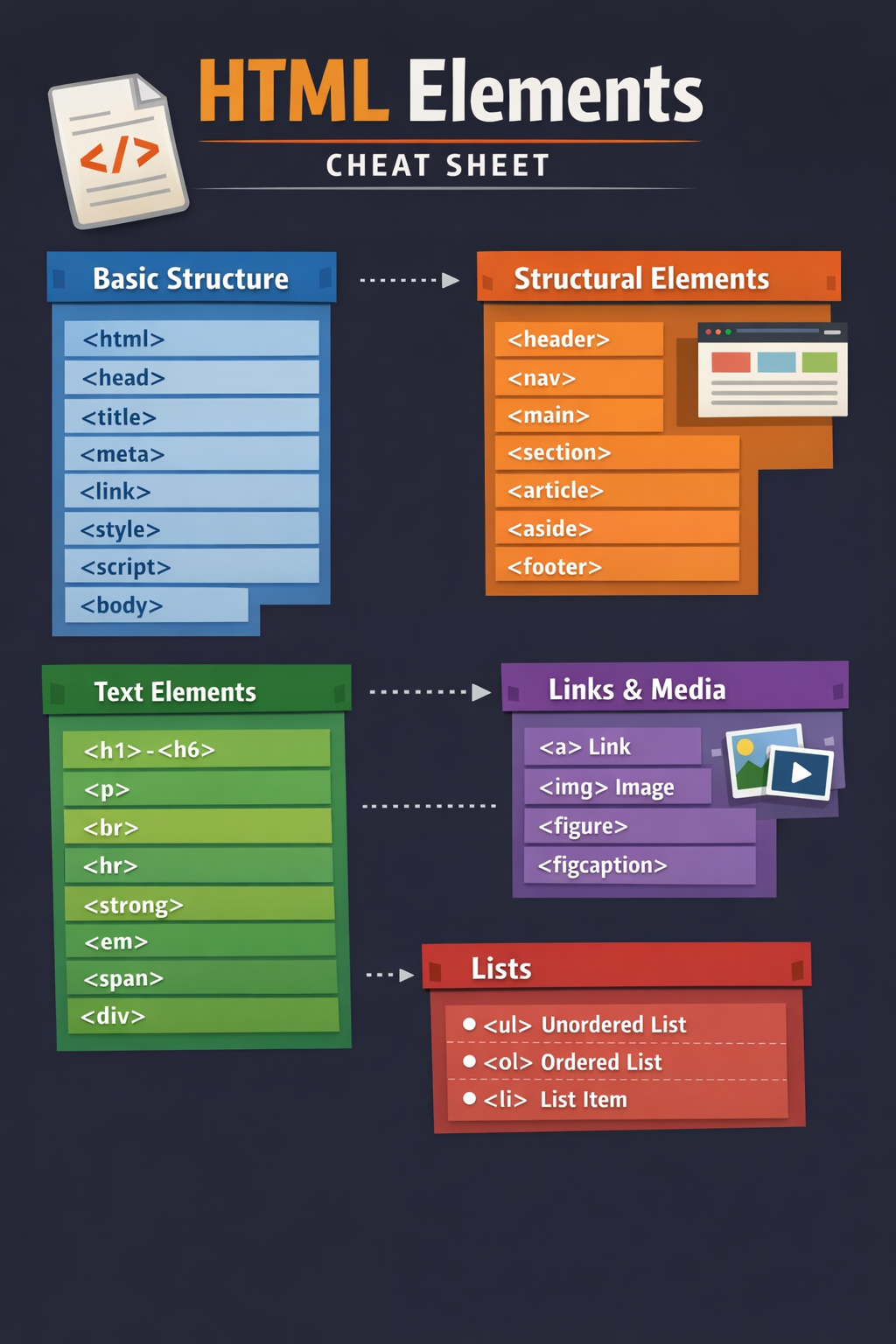
30 Common HTML Elements
- 1. <html>
- Defines the root of an HTML document
- 2. <head>
- Contains meta-information about the document
- 3. <title>
- Sets the title of the document shown in the browser tab
- 4. <meta>
- Defines metadata such as charset and viewport settings
- 5. <link>
- Links external resources like stylesheets
- 6. <style>
- Contains internal CSS styles
- 7. <script>
- Embeds or links to JavaScript code
- 8. <body>
- Contains the visible content of the page
- 9. <header>
- Represents introductory content or navigation links
- 10. <nav>
- Defines a set of navigation links
- 11. <main>
- Specifies the main content of the document
- 12. <section>
- Defines a thematic section of content
- 13. <article>
- Represents self-contained content like a blog post
- 14. <aside>
- Defines content tangentially related to the main content
- 15. <footer>
- Represents the footer of a section or page
- 16. <h1>
- Defines the most important heading
- 17. <h2>
- Defines a second-level heading
- 18. <h3>
- Defines a third-level heading
- 19. <h4>
- Defines a fourth-level heading
- 20. <h5>
- Defines a fifth-level heading
- 21. <h6>
- Defines the least important heading
- 22. <p>
- Defines a paragraph of text
- 23. <br>
- Inserts a line break
- 24. <hr>
- Inserts a thematic break or horizontal line
- 25. <strong>
- Defines important text displayed in bold
- 26. <em>
- Defines emphasized text displayed in italics
- 27. <span>
- An inline container for styling or targeting text
- 28. <div>
- A block-level container for grouping content
- 29. <a>
- Defines a hyperlink to another page or resource
- 30. <img>
- Embeds an image into the page